|
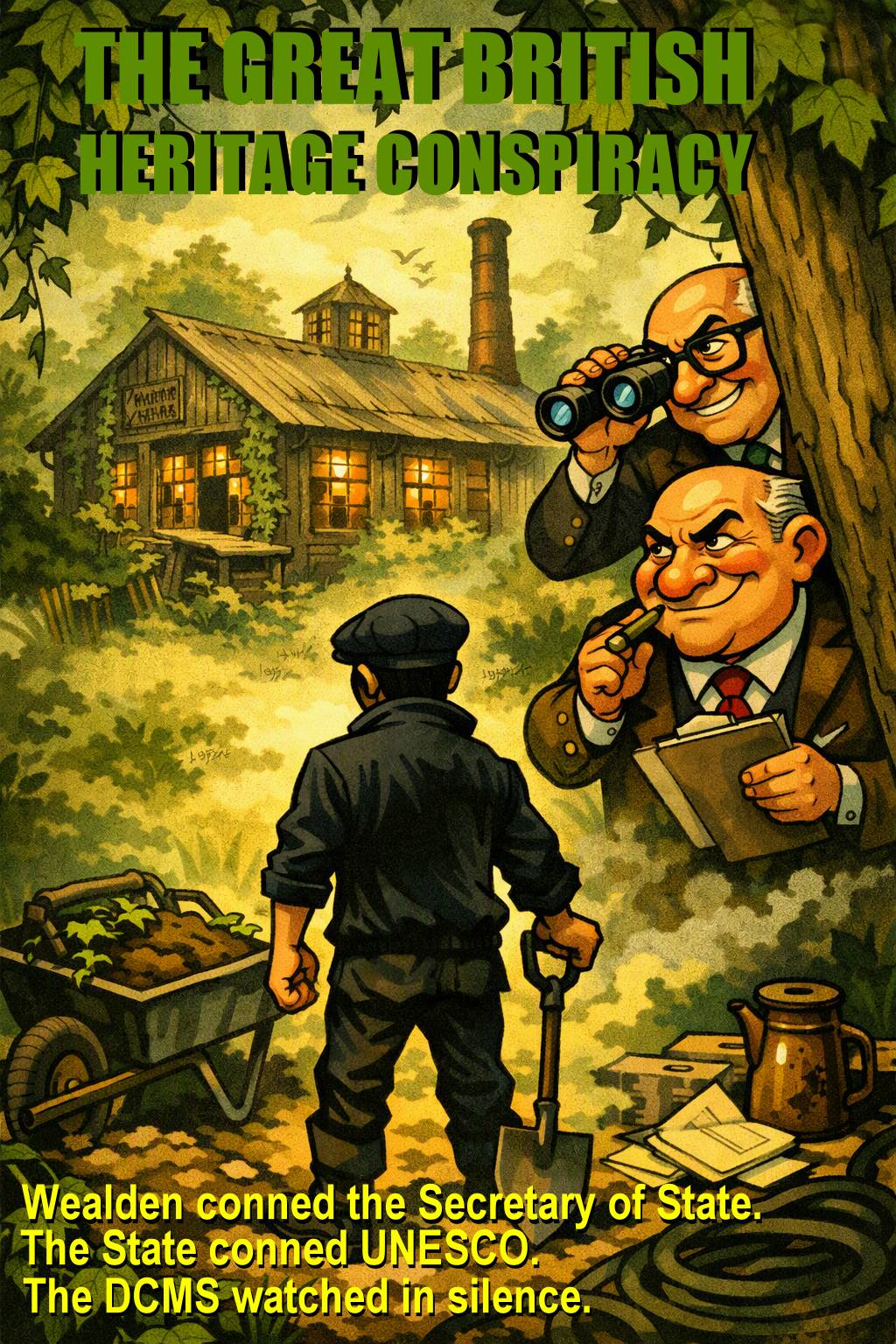
When
a craftsman restores a forgotten 1896 electricity generating station in
rural Sussex, he unwittingly uncovers a forty-year conspiracy involving
corrupt officials, buried heritage, destroyed evidence, and a council
willing to ruin his life — forcing him into a decades-long battle
against the quiet brutality of the British administrative machine.
"THE
GREAT BRITISH HERITAGE SWINDLE": by
THE INJUSTICE ALLIANCE
Genre:
Political Thriller DocuDrama Based on True Life Events
optioned
free of royalties, to production companies.
(Read
110 page .pdf 1st draft script) Casting,
Director
& Producers, Pitch
Deck, Production
DOCUDRAMA
SCRIPT — ACT I, CHAPTER 1
“THE
SHADOW IN LIME PARK”
Adapted for television — First-person narration, political thriller
tone, comedic undertones
EXT. LIME PARK – SUMMER 1982 – DAY
A quiet Sussex estate. Sunlight filters through Victorian trees. Birds
chirp with the smug self-assurance of creatures who have never filled
out a planning application.
NARRATOR (V.O.)
Forty years on, with the ivy creeping over the old brick footings and
the council’s decision letters yellowing like nicotine stains, I
marvel at my own naivety. I genuinely believed — God help me — that
civil servants were honest, local government obeyed the rule of law, and
that a man’s home, once bought and paid for, was his own.
A car pulls up. Out steps NICOLAI
ASKAROFF, dignified, White Russian accountant, carrying a ring of
keys like a man surrendering a kingdom.
EXT. GENERATING SHEDS – CONTINUOUS
Nicolai hands the keys to VICTOR VON WOOLFE — younger, earnest, grease
under his fingernails, unaware he is about to become the protagonist of
a forty-year bureaucratic siege.
NICOLAI
(soft, courtly)
She’s yours now, Victor. Redwood from Canada. Built in ’96. A marvel
of her age. And a burden of mine.
NARRATOR (V.O.)
Nicolai was a practical man — a shrewd chartered accountant, courtly, and acutely aware of
the burdens of property. He sold me the sheds partly to limit his own
liability, but mostly because he knew I was a craftsman. He knew I had
the hands, the patience, and the bloody-minded stubbornness needed to
restore the timbers and clear the fauna.
Victor steps inside. Dust motes dance in the sunlight. Beneath the rot,
the massive concrete engine beds lie like sleeping giants.
NARRATOR (V.O.)
I thought I was restoring a building. I didn’t realize I was
unearthing a crime scene the British civil service would spend the next
four decades trying to bury.
EXT. LIME PARK – VARIOUS – DAYS PASS
Victor works tirelessly: sawing, clearing brambles, hauling ivy,
revealing brick footings and concrete mounts.
NARRATOR (V.O.)
The sheds sat at the edge of Lime Park — a quiet, sun-dappled haven of
Victorian estates and whispering trees. But we were outsiders. Nicolai
was an émigré. I was von Woolfe — a name that didn’t sit
comfortably within the parish fold.
Two local residents peer from behind lace curtains, whispering.
NARRATOR (V.O.)
Two residents, perturbed by my presence and the sound of my workshop,
began whispering into the ears of the Parish Council. And from there,
the grievance floated up the administrative food chain to the district
officers at Wealden.
INT. WEALDEN
DISTRICT COUNCIL – BACK OFFICE – DAY
A drab office. Beige walls. A dying pot plant. The smell of lukewarm tea
and quiet malice.
NARRATOR (V.O.)
Local government, as Sir Humphrey Appleby might have observed, is rarely
about governing. It is about the quiet management of influence.
The CHIEF EXECUTIVE, a man who looks like he was carved from cold suet,
stands at the window.
CHIEF EXECUTIVE
(over tea)
Dig all the dirt you can find, Ian. Bury this mother-fucker.
IAN KAY, Assistant District Planning Officer, thin moustache, tight
mortgage, opens a fresh manila folder.
IAN
The committee won’t know a damn thing about the 1896 history, Chief.
I’ll bury the whole building under his tree works, his car
maintenance, alleged unauthorized storage…
CHIEF EXECUTIVE
Excellent, Ian. By the time we’re through with him, von Woolfe will be
begging to sell at any price.
They exchange a quiet, knowing smile — the kind shared by middle-tier
bureaucrats who know the machinery of state enforcement is entirely at
their disposal.
CHIEF EXECUTIVE
And just for good measure… make sure enforcement officers turn up
every Friday afternoon. Just before the weekend.
IAN
Harass the bastard?
CHIEF EXECUTIVE
Harass the hell out of him.
Ian hesitates — a flicker of conscience, quickly smothered by the
weight of his mortgage.
IAN
Isn’t Ashley Brown an amateur archaeologist? Perhaps we can procure
the site for him once we’ve squeezed von Woolfe out?
CHIEF EXECUTIVE
A very public-spirited thought, Ian.
Ian swallows.
IAN
Is any of this… strictly legal?
The Chief looks up, eyes cold above his reading glasses.
CHIEF EXECUTIVE
Legal? Since when has that ever bothered you before, Ian?
Ian nods, defeated, and writes “Friday harassment
schedule” in his notebook.
EXT. GENERATING SHEDS – SUNSET
Victor stands alone, surveying the building he has begun to resurrect.
NARRATOR (V.O.)
Of all this, I knew precisely nothing. While the administrative
machinery was being quietly oiled in the council offices, I was out in
Lime Park in my overalls, working from dawn until dusk.
Victor uncovers the vast concrete mounts — monolithic, silent.
NARRATOR (V.O.)
With every armful of brambles dragged away, the building yielded up its
secrets. It was a place of profound industrial beauty.
Victor wipes sweat from his brow, unaware of the storm gathering behind
him.
NARRATOR (V.O.)
I thought I was restoring a building.
I didn’t realize I was unearthing a crime scene that the United
Kingdom’s civil service would spend the next forty years trying to
cover up.
FADE OUT.
DOCUDRAMA
SCRIPT — ACT I, CHAPTER 2
“THE
FALL OF VICTOR (1982)”
First-person narration, political thriller tone, comedic undertones
INT. WEALDEN DISTRICT COUNCIL – COMMITTEE ROOM – LATE AUTUMN 1982
– DAY
A drab, wood-panelled room. Beige carpet. A faint smell of damp paper
and institutional indifference. Councillors shuffle in, clutching
folders and tepid tea.
NARRATOR (V.O.)
There is a particular kind of violence unique to the English committee
room. No raised voices, no heavy boots. Just muffled tones, lukewarm
tea, and the smooth, impenetrable jargon of “public interest.”
A sign on the door reads: PRIVATE SESSION — MEMBERS ONLY.
Inside, IAN KAY sits at the head of the table, a manila folder before
him like a loaded weapon. ASHLEY BROWN lurks in the shadows, eyes
gleaming with archaeological ambition. VICTORIO SCARPA, the council’s
legal officer, hovers nearby — a vulture in a suit.
NARRATOR (V.O.)
The official agenda listed routine items. But the real business of the
day was unwritten: the character assassination of a newcomer who had
committed the unforgivable sin of minding his own business on
historically valuable ground.
Kay clears his throat with theatrical gravitas.
INT. COMMITTEE ROOM – CONTINUOUS
IAN KAY
We have received a number of letters… from deeply concerned residents
in a park just outside Herstmonceux village.
NARRATOR (V.O.)
It was a masterful opening. Every councillor knew the history of Lime
Park — Baron von Roemer, his son Charles, the 1896 coal-gas generating
station. They had whispered about it for weeks. But around this table,
an unspoken pact held firm: no one was to utter a single word about the
history. To acknowledge the building’s heritage would be to give it
value — and value was precisely what they needed to strip away.
Kay leans forward, lowering his voice.
IAN KAY
The situation is delicate. Mrs. Elizabeth Cowling and Mr. Raymond
Hanchard-Goodwin were not consulted regarding the sale of these… sheds
near The Rectory. The churchwardens are anxious. They claim the
clearance work is disturbing the Rector.
A few councillors exchange puzzled looks.
NARRATOR (V.O.)
In truth, the clearance work was vital structural husbandry — removing
choking sycamores that were actively dismantling the timber framework.
But in the language of Wealden District Council, saving a historic
structure from collapse was reframed as “disturbance.”
Kay flips a page.
IAN KAY
The church has suddenly realized the site’s potential. A brick coal
bunker has been uncovered, along with a concrete bomb shelter from the Second
World War. They are naturally eager to purchase the land back — if
the price is right.
Ashley Brown’s eyes flicker with acquisitive interest.
INT. COMMITTEE ROOM – CONTINUOUS
Kay shifts gears.
IAN KAY
Furthermore, the individual currently occupying the site — this von
Woolfe character — is using the front garage to repair his own motor
vehicles. We have reports he is even constructing a sports car of his
own design. Welding, metalwork, visitors… all happening on the
doorstep of respectable parishioners.
A councillor frowns.
COUNCILLOR #1
Are these trees he’s removing not simply weed trees? Sycamores?
Another councillor leans forward.
COUNCILLOR #2
And if the property includes a garage, surely a man is entitled to
service his own car or build a special in his own workshop?
Kay’s foot taps irritably under the table.
NARRATOR (V.O.)
Kay didn’t like dissent. Even from useful idiots.
He lowers his voice into a conspiratorial purr.
IAN KAY
That may well be, gentlemen. But let us be frank. Nobody in the Park
likes the Russian
at Number 4. And this Woolfe fellow… he’s from South Africa. Worse
still, he’s had a previous brush with the law. He is, to put it
bluntly, a bounder and a cad.
A murmur ripples through the room.
NARRATOR (V.O.)
Personal vulnerability — a past mistake, an outsider’s accent, a
lack of local lineage — was precisely the leverage Kay needed.
Kay delivers the coup de grâce.
IAN KAY
And the Church would very much like to acquire the property.
The chairman looks up.
CHAIRMAN
Is it actually for sale, Mr. Kay?
Kay shrugs.
IAN KAY
The point, Chairman, is that but for these troublesome newcomers, this
site fronts onto open land that we may well wish to see developed for
housing in years to come. If these wooden sheds are restored and
recognized, their presence could severely impact the develop-ability of
that expansion site.
The chairman blinks.
CHAIRMAN
And who owns that agricultural site, Mr. Kay?
IAN KAY
A highly respected local farmer. Look, these sheds are worthless. It is
in all our interests that they remain that way.
A heavy silence. Councillors who know the truth look down at their
hands.
NARRATOR (V.O.)
They knew the truth. But they also knew how the wind blew in Wealden.
They chose the quiet cowardice of abstention.
Kay presses on.
IAN KAY
How would any of you feel if a neighbour started building a sports car
next door to you? The man should have rented an industrial unit in
Hailsham. We simply don’t tolerate upstarts in the countryside.
The chairman sighs.
CHAIRMAN
Let us take a vote.
Hands rise — quickly, obediently. A few hesitant members are stared
down until their hands rise too.
VIC SCARPA
Carried.
Kay leans back, smirking.
NARRATOR (V.O.)
Woolfe is mine, he thought. The sheer thrill of inflicting bureaucratic
ruin on a helpless target warmed him far more than any cup of council
tea.
INT. DRAFTY CORRIDOR – MOMENTS LATER
Councillors file out. Scarpa falls into step beside Kay.
SCARPA
You know, Ian… this chap Woolfe… he has absolutely no knowledge of
planning law whatsoever. He’s a complete babe in the woods.
Kay chuckles, pulling on his coat.
IAN KAY
Good. That will make burying him all the easier.
EXT. LIME PARK – DUSK
Victor stands alone, unaware of the vote that has just sealed his fate.
NARRATOR (V.O.)
And so began my fall — not with a bang, but with a quiet vote in a
carpeted room, taken by men who had never once set foot inside the
building they condemned.
FADE OUT.
DOCUDRAMA
SCRIPT — ACT I, CHAPTER 3
“THE
SECRET REPORT (1985)”
INT. WEALDEN DISTRICT COUNCIL – RECORDS ROOM – NIGHT (PRESENT DAY)
A dim, dusty archive. A single desk lamp casts a pool of yellow light.
SHERLOCK CHESTERFIELD, late 50s, meticulous, bespectacled, flips through
a stack of pink confidential folders.
NARRATOR (V.O.)
In the dark corners of British local government, the most lethal weapons
are never published. They exist as “exempt information” — pink
folders circulated in secret, retrieved at the door, and kept hidden
from the target.
If only I had seen the 1985 report… I might have stood a chance.
Chesterfield freezes. His eyes widen.
He lifts a folder marked: ENFORCEMENT REPORT — CONFIDENTIAL — 1985.
NARRATOR (V.O.)
Decades later, an investigator digging into Wealden’s negligence would
accidentally be shown that very document.
A bomb with a forty-year fuse.
Chesterfield opens it. His face darkens.
INSERT — THE SECRET REPORT (1985)
Typed pages.
No mention of “1896.”
No mention of “heritage.”
Just: CHARACTER CONCERNS REGARDING OCCUPIER.
INT. RECORDS ROOM – NIGHT
Chesterfield mutters under his breath.
CHESTERFIELD
Good God… they scrubbed the history clean.
He flips another page.
CHESTERFIELD
This isn’t planning law. It’s a bloody character assassination.
He snaps the folder shut.
NARRATOR (V.O.)
The Human Rights Act was still fifteen years away.
Back then, enforcement reports were treated like state secrets — the
suspect blindfolded until the trap was sprung.
FLASHBACK — INT. WEALDEN DISTRICT COUNCIL – CHIEF EXECUTIVE’S
OFFICE – 1983 – DAY
A polished mahogany desk.
A haze of cigarette smoke.
CHIEF EXECUTIVE KENNETH WILSON, mid-50s, cold, calculating, leans
forward.
Across from him sits IAN KAY, younger, nervous, eager to please.
WILSON
We don’t want any more public footpaths over that field.
Kay sits bolt upright.
KAY
Yes sir, Mr. Wilson, sir.
WILSON
The farmer’s a personal friend.
And that upstart von Woolfe had the cheek to appeal the Tree
Preservation Orders we slapped on his sycamores.
Wilson lights a cigarette, smirking.
WILSON
A valiant effort, Ian. Useless, of course.
The trees will choke the building and fuck things up nicely for that
bastard.
Kay swallows hard.
INT. CHIEF EXECUTIVE’S OFFICE – CONTINUOUS
Wilson leans back, tapping ash into a glass tray.
WILSON
When we issue the enforcement notice, you tell officers one story:
That the timber structure is a modern building on the site of an old,
demolished power house.
Kay hesitates.
KAY
Will the committee swallow that, Chief?
The timbers are clearly Victorian redwood.
Wilson’s expression hardens.
WILSON
They’ll swallow whatever we put in front of them.
Our solicitor will toe the party line — if he values his pension.
The word pension hangs in the air like a loaded gun.
Kay stiffens.
INT. CHIEF EXECUTIVE’S OFFICE – CONTINUOUS
KAY
So… we don’t mention anything to the County Archaeologist?
Or English Heritage?
Wilson stares at him.
WILSON
Are you stupid, Mr. Kay?
We state categorically that the building has no historic value
whatsoever.
Kay nods, chastened.
KAY
And the Planning Inspectorate?
Will they just take our word for it?
Wilson smiles — thin, predatory.
WILSON
We make sure Inspector Raymond Dannreuther is appointed.
Old chum of Peter Townley at The Old Rectory.
They served in the Navy together.
Kay exhales slowly. The penny drops.
KAY
Ah. A complete setup.
Dannreuther will write whatever findings we need.
Wilson winks.
WILSON
Now you’re catching on.
INT. CHIEF EXECUTIVE’S OFFICE – CONTINUOUS
KAY
And Derek Holness?
Wilson chuckles.
WILSON
His Holiness knows the score.
His future appointment depends entirely on following our setup — all
the way through Dannreuther and beyond.
Kay nods grimly.
KAY
He’ll keep the lie going to his grave.
WILSON
Why wouldn’t he?
A golden handshake at the end.
A big, fat, tax-free lump sum for doing the dirty work.
Kay grins, emboldened.
KAY
All at the taxpayer’s expense, Chief.
Wilson rises, laughing.
WILSON
What the taxpayer doesn’t know won’t harm them, Ian.
They pay what we demand — or we send the bailiffs and put them in
prison.
Their laughter echoes down the quiet, carpeted corridor.
NARRATOR (V.O.)
They had no idea the paper trail they were leaving behind.
INT. RECORDS ROOM – NIGHT (PRESENT DAY)
Chesterfield closes the folder with a soft thud.
NARRATOR (V.O.)
And so the secret report — the one that condemned me — finally
surfaced in 2025.
Dropped like an unexploded bomb before Inspector Simon Hand.
Chesterfield turns off the lamp.
Darkness.
NARRATOR (V.O.)
The truth was always there.
Buried.
Waiting.
FADE OUT.
ACT
I:
SCENE
4 -
THE INSPECTORATE DECEPTION 1987
INT. WEALDEN DISTRICT COUNCIL — PUBLIC INQUIRY ROOM — DAY (1987)
Fluorescent lights hum overhead.
A sterile, windowless chamber.
Rows of wooden benches.
A faint smell of disinfectant and stale paper.
I sit alone, watching the choreography unfold.
NARRATOR (V.O.)
To the untrained eye, it looked like due process.
To me, it was theatre — a verdict written long before the first
witness took the stand.
At the front sits INSPECTOR RAYMOND DANNREUTHER, 60s, immaculate suit,
military posture.
His eyes scan the room with the calm detachment of a man who has
commanded fleets.
NARRATOR (V.O.)
Former Naval Commander.
Assistant Deputy Chief of Naval Operations.
Author of Somerville’s Force H.
A man of formidable intellect.
And a man with a qualification never disclosed on the official register:
He lived down the road in Bexhill.
And he was a close personal friend of Peter Townley — the man who
wanted my land.
Dannreuther
adjusts his glasses.
A subtle nod to the council’s solicitor.
A signal.
A pact.
INT. INQUIRY ROOM — LATER
A HOUSING OFFICER takes the stand.
Nervous. Sweaty.
He reads from a prepared statement.
HOUSING OFFICER
Mr. von Woolfe applied for housing benefit…
and carried out unauthorized tree works…
I clench my jaw.
NARRATOR (V.O.)
Lies.
Manufactured falsehoods.
No benefit applications existed.
And the tree works?
A qualified arboriculturist had already confirmed they were essential to
stop the building being crushed.
Another officer steps forward.
PLANNING OFFICER
The structure is domestic in nature…
I stare at him.
NARRATOR (V.O.)
The site was rated non-domestic commercial property.
Industrial use from 1896 onward.
Farm office.
Sawmill.
All scrubbed from the record.
Dannreuther writes nothing.
He simply watches.
INT. INQUIRY ROOM — CONTINUOUS
I rise.
Walk toward the Inspector’s table.
NARRATOR (V.O.)
Crucially, he made no mention of English
Heritage.
No mention of the County Archaeologist.
He appointed himself an expert historian — a field in which he held no
qualifications whatsoever.
Dannreuther meets my eyes.
His expression unreadable.
EXT. LIME PARK — SITE VISIT — DAY
Cold air.
Damp grass.
The timber sheds loom like ghosts of a forgotten age.
I lead Dannreuther across the field.
Council officers follow behind, whispering.
NARRATOR (V.O.)
This was the moment.
The evidence chain they couldn’t bury.
I stop at the largest shed.
Push open the door.
Inside:
Two massive concrete engine mountings.
Aligned with mathematical precision.
ME
And here, Inspector, are the main engine mounts.
Perfect alignment for a Crompton DC generator.
Dannreuther steps closer.
His breath catches — barely perceptible.
We move to the smaller shed.
I kneel.
Brush away leaf litter.
Rows of thick, ribbed glass isolation cups emerge — intact.
ME
Over a hundred glass cups, Inspector.
Designed to catch acid condensation from the lead-acid accumulators.
Dannreuther freezes.
Looks over his shoulder at the council’s solicitor.
A silent exchange.
NARRATOR (V.O.)
A look that said:
“How do you expect me to overcome this evidence chain, you fools?”
The solicitor gives a subtle wink.
Dannreuther straightens.
His face resets — cold, official, unreadable.
NARRATOR (V.O.)
That wink sealed the deal.
He was expected to lie — and lie convincingly.
INT. INQUIRY ROOM — DAY (LATER)
Dannreuther reads his Decision Letter aloud.
His voice is steady.
Controlled.
Practiced.
DANNREUTHER
The concrete mounts are a matter of fact and degree…
The timber building is a modern structure…
built over the footprint of an earlier, long-vanished power house.
I stare at him.
NARRATOR (V.O.)
To believe him, you’d have to accept he was an archaeological moron.
But a former Assistant Deputy Chief of Naval
Operations is no idiot.
He knew exactly what he was doing.
He closes the file.
NARRATOR (V.O.)
To force me into selling the premises to his old naval chum,
he had to convince me the historic treasure
I was preserving
was legally and historically worthless.
INT. WORKSHOP — NIGHT (1999)
A knock at the door.
A WELL-WISHER enters.
Hands me a dusty glass framed document.
I wipe the dust away. It is an original document, the instructions to
the Switchboard Attendant, date 1911: "....the village
voltage."
NARRATOR (V.O.)
Twelve years later, an independent archaeological survey confirmed the
truth:
The timber structure was original to 1896. Integrated with the concrete
mounts.
I stare at the document.
NARRATOR (V.O.)
And then came the extraordinary discovery — the original operating
instructions for the Switchboard
Attendant, dated 27 February 1911.
Proof of a pioneering public micro-grid.
I exhale.
Slow.
Disbelieving.
INT. RECORDS OFFICE — DAY (PRESENT)
Chesterfield sits at a desk.
He reads a buried piece of correspondence.
His eyes widen.
CHESTERFIELD
Jesus Christ…
NARRATOR (V.O.)
Decades later, another paper surfaced.
Wealden’s enforcement officer confirming to Townley’s solicitor
that Townley was the council’s “preferred owner.”
A procurement fraud.
Orchestrated from the top.
Protected by police connections.
A web designed to break a man, hide a monument,
and deliver a prize to one of their own.
Chesterfield closes the file.
Darkness.
NARRATOR (V.O.)
The administrative state had closed ranks.
And I was the target.
FADE OUT.
ACT
I:
SCENE
5 -
THE QUIET SURVIVAL 1997
EXT. LIME PARK — DAWN — 1997
Cold coastal rain sweeps across the hillside.
The 1896 generating
station stands alone — timber darkened, ivy clawing at the frame.
I walk toward it, boots sinking into wet grass.
NARRATOR (V.O.)
While the official records called it a modern anomaly, the building
itself refused to die.
Imported redwood. Victorian engineering.
It stood firm — a silent rebuke to Inspector Dannreuther’s lies.
A gust of wind rattles the roof sheets.
The structure holds.
INT. WEALDEN DISTRICT COUNCIL — ENFORCEMENT OFFICE — DAY
A stack of files.
Maps.
Legal notices.
The quiet hum of fluorescent lights.
Council officers whisper in corners.
NARRATOR (V.O.)
Goaded by Peter
Townley and his Lime Park allies, Wealden stepped up their
enforcement efforts.
Their agenda was simple:
Force my surrender.
Deliver the generating station to Townley and Henry Arnell.
Demolish it.
Erase the evidence of their 1986 misfeasance.
INT. CHIEF EXECUTIVE’S OFFICE — DAY
A mahogany desk dominates the room.
DEREK
HOLNESS, 50s, immaculate suit, cold eyes, stares at a map.
He slams it down.
HOLNESS
Fuck me, Ian.
Wilson gave you one job — one — and you cock it up?
IAN KAY, mid-40s, anxious, shifts in his seat.
KAY
The bomb shelter wasn’t included on the boundary overlay, sir.
Legal missed it.
Holness sneers.
HOLNESS
Really?
Scarpa and Phillips?
Kay nods.
Holness leans back, tapping a pen against his teeth.
HOLNESS
My priority is to bury this Woolfe chap once and for all.
Do you understand me?
Kay straightens.
KAY
The senior solicitor now is Christine Nuttall.
Holness’s eyes gleam.
HOLNESS
Ah.
Pure, unadulterated evil.
Excellent.
What’s she proposing?
Kay smiles thinly.
KAY
Bypass the magistrates.
Go straight to the High Court.
Seek an injunction to clear the site completely.
Holness chuckles.
HOLNESS
And full legal costs, I presume?
KAY
Naturally.
It’s not remotely legal, given the omitted areas —
but High Court judges rubber-stamp whatever we put on the crest.
Holness nods approvingly.
INT. CHIEF EXECUTIVE’S OFFICE — CONTINUOUS
Holness pours tea.
HOLNESS
And what about the building’s heritage, Ian?
Kay blinks.
KAY
What heritage, sir?
Holness smirks.
HOLNESS
Quite.
He taps the map again.
HOLNESS
Phillips will front the affidavits.
He’s bent as a butcher’s hook.
Kay grins.
KAY
We’ll include the residential caravan Victor uses.
Holness pauses.
HOLNESS
Is there an active enforcement notice on the caravan?
Kay shrugs.
KAY
No, sir.
But the High Court will happily ride roughshod over his Article 8
rights.
All we need is official letterhead.
Holness nods slowly.
HOLNESS
And his new planning appeals?
He’s raised the 1896 heritage issues again.
Kay waves a dismissive hand.
KAY
Inspector Raymond
Michael is assigned.
He’ll look the other way — exactly like Dannreuther
did.
Holness leans forward, voice dropping.
HOLNESS
The Secretary of State is locked into our narrative now, Ian.
Because Dannreuther lied for us in ’87, the Ministry cannot afford to
admit the truth.
Kay’s eyes widen.
KAY
You mean the Planning Inspectorate is party to the cover-up?
Holness laughs — cold, dry.
HOLNESS
My dear fellow…
They are party to the cover-up of the cover-up.
The maximum sentence for criminal conspiracy in public office is life
imprisonment.
The state will say or do whatever is necessary to protect its own.
INT. CHIEF EXECUTIVE’S OFFICE — LATER
A thick paper file sits on Holness’s desk.
He taps it rhythmically.
HOLNESS
We have eleven complaints here, Ian.
Citizens asking uncomfortable questions about our 1987 findings.
Kay frowns.
KAY
Do we respond?
Holness chuckles.
HOLNESS
Good heavens, no.
We bounce the lot straight to Sussex Police.
Kay raises an eyebrow.
KAY
Will Detective Superintendent Wilson run a formal investigation?
Holness smirks.
HOLNESS
Why would Grenville investigate his own father’s old council?
He opens a drawer.
Inside: a stack of blank Sussex
Police
letterhead.
Kay stares.
KAY
Blank police letterhead?
Holness hands him a draft letter.
HOLNESS
We write whatever clearance statement we require.
Print it onto their crest.
File it in the audit record.
The police don’t spend a penny.
We get an official letter saying there’s “no evidence of criminal
misfeasance.”
Kay laughs.
KAY
Brilliant, Chief.
A police whitewash — written by us, signed by no one, paid for by the
ratepayer.
Holness winks.
HOLNESS
Standard operating procedure.
Now let’s get that High Court injunction before the archaeologists
start sniffing around.
EXT. LIME PARK — TWILIGHT
The generating station stands in silhouette.
Ivy creeps higher.
Roof sheets sag.
NARRATOR (V.O.)
While the bureaucrats plotted, the physical reality was stark.
Deprived of lawful commercial use, the 1896 station had no income to pay
for repairs.
No timber treatments.
No roof work.
Just me — and the relentless Sussex weather.
I run my hand along the timber.
It flakes under my touch.
NARRATOR (V.O.)
English Heritage warned that industrial history was being flushed down
the toilet.
Phillips and Nuttall knew.
They didn’t care.
Their loyalty lay with wealthy neighbours — not the truth.
INT. WEALDEN DISTRICT COUNCIL — AFTERNOON TEA ROOM — DAY
Holness and Kay sit with tea and biscuits.
Holness tosses a fresh appeal decision into a drawer.
HOLNESS
Well, Satan’s sinners, Kay…
Turns out central government is even more corrupt than we are.
Kay smirks.
KAY
Let’s see Victor
Woolfe get out of that one.
Holness raises his teacup.
They toast.
EXT. LIME PARK — NIGHT
Rain falls.
The generating station stands alone — battered, but still standing.
NARRATOR (V.O.)
They tried to bury me.
They tried to bury the building.
But the truth — like the timber — refused to rot.
FADE OUT.
ACT
II:
SCENE
6 - TROWELS AND TIMBER 1998
EXT.
LIME PARK — SPRING MORNING — 1998
Birdsong.
A soft breeze.
The timber sheds stand weathered but defiant, their redwood frames
catching the early light.
I walk across the grass, boots damp with dew.
NARRATOR (V.O.)
In the dark trade of political cover-ups, physical evidence is the
ultimate nuisance.
You can bribe an officer, lean on a chairman, or procure a conveniently
blind Inspector —
but you cannot persuade a hundred-year-old baulk of pitch-pine to lie.
A car pulls up.
Door opens.
RON
MARTIN, 50s, rugged, practical, steps out holding a trowel.
He looks around, unaware he’s stepped onto an administrative landmine.
EXT. LIME PARK — CONTINUOUS
Ron walks the perimeter of the sheds, measuring, pacing, frowning.
NARRATOR (V.O.)
Ron Martin — Sussex Industrial Archaeology Society.
Restorer of the 1814 Windmill
Hill post mill.
A man backed by the Heritage Lottery Fund.
A man Wealden couldn’t bury under paperwork.
Ron stops.
Runs a calloused hand along the iron-grey redwood.
RON
Good God, Victor…
How has this place remained unmentioned in the local historic firmament?
He kneels, inspecting the timber joints with forensic care.
INT. RON’S CAR — LATER
Ron scribbles furiously in a notebook.
NARRATOR (V.O.)
He knew nothing of Inspectors Dannreuther or Michael.
Had he read their decision letters, his hair would have stood on end.
To an honest academic, those documents weren’t flawed —
they were grotesque fiction.
Ron finishes writing.
A letter of support — bold, uncompromising.
EXT. LIME PARK — FORMAL SITE VISIT — DAY
Council members arrive.
Clipboards.
Umbrellas.
Expressions of polite disinterest.
Ron stands beside me, pointing at the massive concrete engine mountings.
RON
Here — the flywheel recess for the National gas engine.
And there — the alignment for the Crompton DC dynamos.
Committee members stare blankly.
NARRATOR (V.O.)
The physical proof was staring them in the face.
Even Inspector Raymond Michael had once slipped —
admitting that if development were ever permitted,
the only appropriate consent would be a sympathetic residential
conversion.
Ron turns to me, hopeful.
He doesn’t yet understand the trap.
INT. WEALDEN DISTRICT COUNCIL — AREA PLANS SOUTH COMMITTEE — DAY
A sterile room.
Fluorescent lights.
Muted chatter.
Unbeknownst to the council, SHERLOCK
CHESTERFIELD, 40s, sharp-eyed, sits in the public gallery.
A leather briefcase rests at his feet — rigged with two hidden digital
recorders.
NARRATOR (V.O.)
Sherlock Chesterfield — relentless sleuth for the Wealden Action
Group.
He’d been tracking Ian Kay ever since Kay lied under oath in Horam,
and again over the demolition of a horse sanctuary at Bushywood.
At the front table, VIC SCARPA, council solicitor, clears his throat.
His voice echoes through the chamber — crisp, captured perfectly on
tape.
SCARPA
We simply do not want to give planning permission to this applicant.
Committee members freeze.
Colonel Hubbard, the chair, stares at the table.
No one speaks.
No one objects.
NARRATOR (V.O.)
They’d been assured councillors enjoyed absolute immunity.
That legal would shield them.
They traded their statutory duties for administrative comfort.
Sherlock presses a button inside his briefcase.
The recorder whirs silently.
EXT. LIME PARK — AFTERNOON
Ron returns, shaken.
He stands beside the engine mounts, struggling to find words.
RON
Victor…
I’ve never seen anything like this.
They aren’t just being difficult.
They’re acting like outright crooks.
I nod.
ME
They are crooks, Ron.
The council conspired with a Planning Inspector in ’87
to fabricate a finding of fact —
to devalue this heritage asset
so a preferred neighbour could buy it cheap.
Ron stares at me, stunned.
RON
A Planning Inspector?
A former Naval Commander?
Victor… surely not.
That sounds insane.
I pull a faded copy of Dannreuther’s 1987 Decision Letter from my
folder.
Hand it to him.
Ron reads.
His eyes widen.
He looks down at the massive Victorian concrete beds at his feet.
RON
Is this man completely deranged?
He’s claiming this footprint has nothing to do with an engine!
I shake my head.
ME
No.
He wasn’t deranged.
He was on the payroll.
Ron looks confused.
RON
You mean… money in an envelope?
I laugh softly.
ME
Good heavens, no.
This is the British establishment —
they don’t use brown envelopes.
Far too vulgar.
Leaves a paper trail.
Ron waits.
ME
You give an Inspector a quiet, frictionless planning permission
on one of his own residential developments in Bexhill
or Hastings.
Untraceable.
Highly lucrative.
Completely off the books.
Ron looks at the timbers again.
Then at the letter.
Then at me.
The scale of the machine dawns on him.
RON (whispering)
My God…
It’s a complete setup.
EXT. LIME PARK — SUNSET
The sheds stand in silhouette.
Unmoved.
Unbroken.
NARRATOR (V.O.)
In the end, the timber
told the truth.
The concrete told the truth.
The archaeology told the truth.
Only the state refused to listen.
FADE OUT.
ACT
II:
SCENE
7 - LONDON TIME TEAM 2000
EXT. COUNTY HALL, LEWES — MORNING — 2000
A dull concrete monolith rises against a grey Sussex sky.
I step out of my car, archive folders under my arm.
NARRATOR (V.O.)
County Hall.
East Sussex’s administrative bunker.
If truth existed anywhere in this county, it would be buried down here
—
in the basement.
INT. COUNTY HALL — BASEMENT OFFICE — DAY
A cramped room lined with map drawers, rolled plans, and dusty reference
works.
DR.
ANDREW WOODCOCK, 40s, soft-spoken, academic, sits at a desk.
He looks up, polite but skeptical.
WOODCOCK
If this building exists as you describe, Mr. Woolfe…
then Wealden should have applied PPG15 and PPG16.
He reaches for two thick government binders.
Slides them across the desk.
WOODCOCK
Have a look.
I open them.
Statutory guidelines.
Obligations.
Mandatory consultations.
My blood simmers.
ME
It says the County Archaeologist must be consulted on any planning
application involving a potential heritage asset.
Woodcock nods.
WOODCOCK
Correct.
ME
And yet you’ve never heard of the generating station at Lime Park?
Woodcock taps his keyboard.
Searches the County Historic Environment Record.
WOODCOCK
Nothing.
No entries for 1986, 1996, or 1997.
Zero.
I stare at him.
NARRATOR (V.O.)
A decade of enforcement.
Two public inquiries.
High Court threats.
And Wealden never once notified the County Archaeologist.
Woodcock brightens suddenly.
WOODCOCK
You’re in luck, though.
Ashley Brown at Wealden is an amateur archaeologist.
Sits on several committees.
A cold surge of fury hits my chest.
I keep my voice level.
ME
Ashley Brown.
How very useful to know.
Woodcock photocopies pages from the binders.
WOODCOCK
English Heritage must also be notified whenever a surviving industrial
structure of potential national significance is affected.
Any late-Victorian installation should go straight to them.
The scale of the deception becomes painfully clear.
NARRATOR (V.O.)
This wasn’t oversight.
It was a coordinated agenda —
to prevent independent experts from ever discovering the truth.
Woodcock hands me the photocopies.
WOODCOCK
Why not contact English Heritage directly?
And DCMS.
I’m sure they’d be fascinated.
ME
You can bet your life I will.
EXT. HERSTMONCEUX — OVERGROWN FIELDS — AFTERNOON
I walk through the quiet fields beside the generating station, cooling
my temper.
NARRATOR (V.O.)
Fifteen years of labor.
Brambles cleared.
Timbers jacked.
Bulldozers resisted.
All to keep the truth standing.
I enter my workshop.
Dial English Heritage.
INT. WORKSHOP — PHONE CALL — DAY
A specialist answers — sharp, energetic.
SPECIALIST (V.O.)
Mr. Woolfe, what extraordinary luck you called today.
We’re running a nationwide Monuments At Risk Survey — the MARS
project.
I grab a notepad.
ME
Tell me more.
SPECIALIST (V.O.)
Only two surviving early electrical sites are on our register:
Kipling’s home at Batemans…
and Battersea Power Station.
I freeze.
ME
So no one knows about Herstmonceux?
SPECIALIST (V.O.)
Not a soul.
If it exists, you’re the first to tell us.
He promises literature.
A university team will contact me.
INT. WORKSHOP — TWO DAYS LATER — MORNING
The MARS pamphlet arrives.
Less than an hour later — the phone rings.
RESEARCHER (V.O.)
Mr. Woolfe?
Lancaster University.
We’re compiling a national survey for English Heritage.
ME
How can I help?
The researcher is breathless.
RESEARCHER (V.O.)
Could we visit the generating station?
If English Heritage is right, you’re sitting on a treasure.
It may be the only surviving example of an integrated, load-leveling
rural public supply station in the country —
perhaps the world.
A quiet surge of pride washes over me.
NARRATOR (V.O.)
Without my stubborn labor, the redwood frame would have rotted long ago.
Lancaster formally incorporates the station into their Step 3 Report.
INT. DCMS — WHITEHALL — DAY (INTERCUT)
A phone rings.
A civil servant answers.
Listens.
Face tightens.
NARRATOR (V.O.)
And then the iron shutters of the British establishment slammed down.
DCMS places a quiet call to Wealden.
Whatever Holness and Scarpa whisper down the line —
the effect is immediate.
INT. COUNTY HALL — BASEMENT OFFICE — DAY
Woodcock sits at his desk.
His earlier warmth is gone.
He looks nervous.
Guarded.
NARRATOR (V.O.)
Even Woodcock changed.
His academic conscience flickered —
but the civil service had reminded him where his salary came from.
Yet he refuses to let the truth die.
INT. COUNTY HALL — BASEMENT — LATER
Woodcock signs a commissioning order.
NARRATOR (V.O.)
To protect his department —
and to resolve the matter once and for all —
he commissioned an independent survey from Archaeology South East,
University College London.
EXT. LIME PARK — DAY — 1999
A team from UCL arrives.
Survey instruments.
Timber bores.
Trowels.
Clipboards.
They work methodically.
Quiet.
Precise.
Scientific.
INT. WORKSHOP — DAY — 2000
I open the final report.
Peer-reviewed.
Scientific.
Undeniable.
NARRATOR (V.O.)
The redwood building was original.
Constructed in 1896.
Directly tied to the concrete mounts, battery rooms, and cooling
channels.
The truth — finally — in black and white.
INT. WEALDEN DISTRICT COUNCIL — EXECUTIVE OFFICE — DAY
Holness reads the report.
Face pale.
Jaw tight.
Scarpa enters.
Phillips follows.
Silence.
NARRATOR (V.O.)
Inside Wealden District Council and Sussex Police,
the panic was palpable.
The report proved the police’s refusal to investigate the 1997
corruption petition
had not been oversight —
but collusion.
A conspiracy to pervert the course of justice.
A cover-up spanning forty years.
EXT. LIME PARK — SUNSET
The generating station stands in silhouette —
weathered, battered, but victorious.
NARRATOR (V.O.)
The scientific truth was out.
And the establishment had nowhere left to hide.
FADE OUT.
ACT
II:
SCENE
8 - MONUMENT PROTECTION PAPER WALLS
EXT. LIME PARK — EARLY MORNING — 2000
Mist clings to the timber sheds.
The redwood frame stands defiant, weathered but unbroken.
NARRATOR (V.O.)
After Lancaster University and UCL completed their surveys, English
Heritage finally moved.
The 1896 generating station was designated under the Monument Protection
Programme.
The brick coal bunker and subterranean ice well were flagged for
scheduled status.
The redwood building — safeguarded through planning law.
For the first time in decades, the truth had official weight.
But the establishment had other plans.
INT. WORKSHOP — DAY
I sit at my desk, flipping through the English Heritage designation
papers.
NARRATOR (V.O.)
What they didn’t want me to discover was that a binding precedent
already existed —
in London.
I pull out a file.
A photograph of 46 Kensington
Court.
FLASHBACK — INT. KENSINGTON COURT — ARCHIVAL FOOTAGE — 1980s
A gutted interior.
Bare brick.
No machinery.
No mounts.
No flywheels.
NARRATOR (V.O.)
A late-Victorian electrical sub-station.
Reciprocating steam engines.
Lead-acid battery load-leveling.
The urban twin of our rural gas-engine setup.
Despite being gutted, it was granted Grade II listing.
Later converted into luxury flats.
The precedent was undeniable.
INT. WORKSHOP — DAY (BACK TO PRESENT)
I close the Kensington Court file.
NARRATOR (V.O.)
Wealden had petitioned DCMS to suppress this precedent.
Under the World Heritage Convention,
they had a duty of candor.
They lied instead.
Only a dishonest actor — or a complete nincompoop — could miss the
technological parallels.
INT. WEALDEN DISTRICT COUNCIL — IAN
KAY’S OFFICE — DAY
Kay sits at his desk, spectacles glinting.
He dials a secure number.
A MINISTER’S VOICE answers — polished, distant.
MINISTER (V.O.)
Ah, Mr. Kay.
How is Mr. Ashley Brown?
Kay smiles.
KAY
He sends his warmest regards, Minister.
I’m calling about a delicate matter.
The Herstmonceux
generating
station has landed on English Heritage’s Monument Protection
Programme.
A heavy sigh from Whitehall.
MINISTER (V.O.)
Unfortunate indeed.
That complicates the administrative narrative.
Kay leans back, calculating.
KAY
We need time.
If your department issues a formal letter rejecting statutory listing,
this chap Woolfe will exhaust his resources and abandon the effort.
A pause.
MINISTER (V.O.)
And what of the 46
Kensington Court precedent?
Kay smirks.
KAY
What Woolfe doesn’t know cannot harm DCMS or English Heritage.
The Minister chuckles — refined, cynical.
MINISTER (V.O.)
Quite so.
Will English Heritage’s regional directors cooperate?
KAY
I’ve spoken with their executive team.
I explained we have administrative machinery in motion
to acquire the premises and force the occupier into bankruptcy.
The Minister’s tone sharpens.
MINISTER (V.O.)
How are you arranging a bankruptcy?
Kay’s voice drips with satisfaction.
KAY
We secured a High Court costs order — £twenty-six thousand pounds.
More than the distressed value of the site.
A beat.
MINISTER (V.O.)
So the local authority acquires the asset cheaply…
and only then do DCMS
and English
Heritage “discover” its national significance?
Kay’s smile turns cold.
KAY
Precisely, Minister.
Our institutional myopia evaporates the moment Woolfe is buried under
the costs order.
MINISTER (V.O.)
Does he hold clean title?
Kay hesitates.
KAY
Not strictly clean title.
But we are destroying all internal records that evidence otherwise.
The Minister laughs — echoing, aristocratic.
MINISTER (V.O.)
You really are absolute bastards down there in Wealden.
Kay beams.
KAY
Nothing out of the ordinary, Minister.
Just standard local government practice.
MINISTER (V.O.)
Give my regards to Mr. Brown — and your chief rat-catcher, Mr. Holness.
KAY
I shall indeed.
Kay hangs up.
INT. WEALDEN
DISTRICT COUNCIL — KAY’S OFFICE — CONTINUOUS
Kay immediately dials another number.
WARDLE (V.O.)
Ian?
I’m packing boxes — you’ve seen the Harrods kerfuffle.
Speak to Gregory Barker.
He’s newly selected, sensitive, eager to please.
Kay nods.
KAY
Is he reliable on party lines?
Wardle chuckles dryly.
WARDLE (V.O.)
It’s a safe Conservative seat.
He’ll do whatever the association and district council tell him.
Kay smiles.
KAY
Thank you, Charles.
He hangs up.
Pulls my master file from a cabinet.
Stamps a bold red marker across the cover:
NO STATUTORY LISTING — ACTION PENDING
EXT. LIME PARK — SUNSET
The generating station stands in silhouette.
Silent.
Historic.
Targeted.
NARRATOR (V.O.)
The Monument Protection Programme had recognized the truth.
But paper walls in Whitehall were already being built —
to keep that truth buried.
FADE OUT.
ACT
II:
SCENE
9 - THE JUDICIAL REVIEW TRAP
2002
INT. WORKSHOP — NIGHT — 2002
Rain lashes the windows.
My desk is buried under files, survey reports, and correspondence.
I type a letter addressed to The Planning Inspectorate, Bristol.
NARRATOR (V.O.)
I still believed the state operated in good faith.
I still believed corruption was an aberration — not a system.
I hadn’t yet grasped the depth of the collusion.
I seal the envelope.
Drop it into the outbox.
INT. WORKSHOP — DAY — ONE WEEK LATER
A crisp envelope arrives.
Planning Inspectorate crest.
I open it.
The letter is polite.
Chillingly polite.
NARRATOR (V.O.)
They suggested my sole recourse was a Judicial Review.
A masterclass in procedural cynicism.
I read the lines again.
My stomach tightens.
INT. WORKSHOP — CONTINUOUS
I pace the room.
NARRATOR (V.O.)
A Judicial Review is not a remedy.
It is a trap — designed to protect the state from the citizen.
I pull a legal textbook from the shelf.
Flip through pages.
NARRATOR (V.O.)
Six-week time limits.
Procedural minefields.
Tens of thousands of pounds just to cross the threshold.
And “leave” — permission — required from a single High Court
judge.
I slam the book shut.
NARRATOR (V.O.)
A true right never requires permission.
The Inspectorate had offered me nothing.
No solution.
No justice.
Just a door designed to slam shut.
EXT. LIME PARK — DAY — FLASHBACK MONTAGE
A series of hostile enforcement visits:
- Phillips photographing a caravan.
- Nuttall arriving with police backup.
- Officers pacing the boundary with clipboards.
- Cars pulling up.
- Doors slamming.
- More officers.
- More visits.
NARRATOR (V.O.)
By the late 1990s, David Phillips and Christine Nuttall were running the
assault.
An enforcement agency for Peter Townley —
continuing the harassment campaign begun by Wilson and Holness.
A counter on screen ticks upward:
57… 89… 120… 150… 181.
NARRATOR (V.O.)
One hundred and eighty-one visits.
Three to four officers each time.
Sometimes with police.
£2,750 per visit.
Half a million pounds of public money —
spent on a vendetta.
INT. WORKSHOP — NIGHT
I sit at my desk.
Write letters to every elected member of Area Plans South.
NARRATOR (V.O.)
I asked them how they could justify it.
How they could squander public money on personal harassment.
I seal the envelopes.
INT. AREA PLANS SOUTH — COMMITTEE OFFICE — DAY
Councillors read my letters.
Faces harden.
Files close.
Phones are picked up.
NARRATOR (V.O.)
Predictably, the iron shutters slammed down.
They closed ranks with the corrupt officers.
A clerk opens a ledger marked:
RECHARGE BUDGET — GOVERNMENT FUNDS
NARRATOR (V.O.)
They were drawing down government funds to finance their blitzkrieg.
A specialized budget —
designed to hide the cost of corruption.
INT. WORKSHOP — NIGHT
I sit alone, reading the Human Rights Act 1998.
NARRATOR (V.O.)
The stakes could not have been higher.
Criminal conspiracy in public office carries a potential life sentence.
The state protects its own.
I flip to the Articles.
NARRATOR (V.O.)
Article 13 — the right to an effective remedy —
was intentionally omitted from the Act.
A deliberate omission.
A shield for corrupt planning departments and influential landowners.
I close the book.
INT. WEALDEN DISTRICT COUNCIL — ARCHIVE ROOM — FLASHBACK
Old files.
Dust.
Tree Preservation Orders from 1983.
Ian Kay’s signature on every page.
NARRATOR (V.O.)
Lord Nolan warned that planning officers should serve no longer than
five years.
To prevent corrupt networks.
Ian Kay had been entrenched since 1983.
Seventeen years of uninterrupted power.
A God Complex.
Nobody dared challenge him.
INT. WORKSHOP — DAY — 2000
I open the UCL archaeological report.
Peer-reviewed.
Scientific.
Undeniable.
NARRATOR (V.O.)
The evidence validated my 1997 petition.
The truth was out.
Their administrative coffin was sealed.
INT. WEALDEN DISTRICT COUNCIL — CHIEF EXECUTIVE’S OFFICE — DAY
Holness sits alone.
Face pale.
Hands trembling.
He signs a resignation letter.
A large cheque sits beside it.
NARRATOR (V.O.)
Holness negotiated his exit.
A tax-free golden handshake —
hush money for his role in the conspiracy.
I send him a formal letter.
He clears his desk.
Flees.
INT. WEALDEN DISTRICT COUNCIL — EXECUTIVE SUITE — DAY
Two new Chief Executives arrive in succession.
Both read the file.
Both blanch.
Both resign abruptly — one without serving notice.
NARRATOR (V.O.)
The file was radioactive.
Nobody wanted to touch it.
INT. WEALDEN DISTRICT COUNCIL — BOARDROOM — NIGHT
A closed-door meeting.
Councillors whisper.
Phones buzz.
Files are passed around.
NARRATOR (V.O.)
Wealden’s political executive realized mid-level bureaucrats could no
longer contain the fallout.
They needed a hardened operator —
someone accustomed to institutional crisis.
A door opens.
DANIEL GOODWIN, 50s, sharp suit, controlled presence, steps inside.
He places a folder on the table.
The room falls silent.
NARRATOR (V.O.)
That someone was Daniel Goodwin.
FADE OUT.
ACT
III:
SCENE
10 - TAXATION WITHOUT PERMISSION
2008 - 2017
EXT. LIME PARK — DAWN — 2003
Mist drifts across the timber sheds.
A council van pulls up.
A brown envelope drops through the letterbox.
I pick it up.
Open it.
NARRATOR (V.O.)
If you want to observe the administrative state at its most surreal,
look no further than its tax ledger.
A realm where logic goes to die.
Inside:
Non-domestic rating demand — Herstmonceux Electricity Generating
Works.
I scan the figures.
NARRATOR (V.O.)
Zero-rated small business status.
Accurate.
Office.
Archive.
Workshop.
Storage.
For a moment, the world made sense.
INT. WORKSHOP — DAY — 2012
Another envelope.
Another demand.
I open it.
Freeze.
NARRATOR (V.O.)
Around 2012, Wealden quietly stripped away the remaining domestic rating
elements.
No consultation.
No explanation.
Just a silent administrative erasure.
I toss the bill onto a growing pile.
INT. WORKSHOP — MORNING — 2017
A new envelope.
Thicker.
Heavier.
I open it.
My jaw tightens.
NARRATOR (V.O.)
Then, in 2017, the council executed a dizzying U-turn.
With a flick of a pen, the 1896 generating station was re-rated
as a “mixed-use residential and commercial dwelling.”
I stare at the timber walls around me.
Industrial.
Historic.
Not a single square foot of residential space.
INT. VALUATION TRIBUNAL — HASTINGS — DAY
A sterile room.
Fluorescent lights.
A tribunal panel sits behind a long desk.
The VOA ASSESSOR, mid-50s, nervous, adjusts his papers.
VOA ASSESSOR
We… uh… relied on Wealden’s written assertions.
I lean forward.
ME
You never visited the site?
He shakes his head.
VOA ASSESSOR
No.
ME
You never examined the timber walls?
The engine mounts?
The floor plan?
He swallows.
VOA ASSESSOR
No.
NARRATOR (V.O.)
The “independent” Valuation Office had rubber-stamped the
council’s narrative
without a shred of physical verification.
The tribunal chair clears his throat.
Avoids eye contact.
INT. WORKSHOP — NIGHT
I am copied in on a draft letter on behalf of the Lime Park Heritage
Trust. It makes interesting reading.
ME (V.O.)
If the council insists the building is residential,
may we rent it out as such?
Will tenants qualify for housing benefit rebates?
The Trust sends the letter.
Weeks pass.
No reply.
NARRATOR (V.O.)
To reply would be to admit the Trust held lawful rights.
And that contradicted their core narrative.
FLASHBACK — INT. WEALDEN DISTRICT COUNCIL — ARCHIVE ROOM —
1991–1995
Files are pulled from shelves.
Documents shredded.
Boxes removed.
NARRATOR (V.O.)
Between 1991 and 1995, Wealden destroyed internal records
proving I was no longer the sole legal entity on title.
FLASHBACK — INT. COUNTY COURT — 1995
A judge signs an order.
HMRC stamps a file.
NARRATOR (V.O.)
Both the County Court and HMRC recognized the lawful transfer
to a third-party trust structure.
FLASHBACK — INT. CONVEYANCER’S OFFICE — 1996
Steven Allport packs his belongings.
A disciplinary notice sits on his desk.
NARRATOR (V.O.)
When the conveyancer was struck off,
the property fell into legal limbo.
EXT. LIME PARK — DAY — 2006
“DUKE ANDREWS,” 40s, exhausted, walks away from the site.
A folder drops from his hand.
NARRATOR (V.O.)
The trustee walked away —
crushed by endless applications and stonewalling.
We had no UCL survey then.
No scientific proof of Wealden’s lies. The bastards played on this.
INT. WEALDEN DISTRICT COUNCIL — EXECUTIVE OFFICE — 2008
Chief Executive CHARLIE LANT signs a document.
NARRATOR (V.O.)
Under Lant, the residential tax liability was removed.
INT. WEALDEN DISTRICT COUNCIL — EXECUTIVE OFFICE — 2017
Chief Executive TREVOR SCOTT, Planning Director KELVIN WILLIAMS,
and the ever-present shadow of Ian Kay stand over a map.
Scott signs a new order.
NARRATOR (V.O.)
Under new leadership, the liability returned.
A fresh paper trail —
manufactured to fit their plot.
INT. 1896 POWER HOUSE — DAY — 2017
Council officers raid the premises.
They look around — confused.
Staff canteen.
Male and female toilets.
Changing rooms.
Lockers.
Archive.
Workshop.
Rest room.
No residential space.
NARRATOR (V.O.)
Every square foot was non-domestic.
Mandated by Health and Safety Regulations.
There wasn’t room for a flat even if one wanted it.
But physical reality meant nothing.
INT. MAGISTRATES’ COURT — HASTINGS — DAY
A cramped courtroom.
Council officers present their own ledgers.
Clerks shuffle papers.
I hand a skeleton argument to the clerk.
He hands it back.
CLERK
We don’t keep these on record.
NARRATOR (V.O.)
The court wasn’t a court at all.
It was an administrative rubber stamp —
hired out by the council.
No judicial record.
No remedy.
No justice.
An Article 13 violation in its purest form.
EXT. LIME PARK — TWILIGHT
I stand beside the timber frame, holding a stack of tax demands.
NARRATOR (V.O.)
The endgame was never about tax.
It was about breaking me financially.
Softening up the site for Townley, Lime Park Estate Limited —
and later, Thakeham, Latimer, Clarion, Persimmon.
They thought they were spinning a web I could never escape.
I place the demands into a folder marked:
EVIDENCE — LGO / HIGH COURT
NARRATOR (V.O.)
But with every fraudulent demand,
every rubber-stamped summons,
every evasive letter —
I wasn’t just enduring their harassment.
I was assembling an unassailable dossier.
The rope they spun to hang me
would become the rope that bound them
to forty years of misfeasance in public office.
FADE OUT.
ACT
III:
SCENE
11 - THE QUIET CORRIDOR OF
PARLIAMENT 2015-2018
EXT. CHAPEL GREEN — EARLY MORNING — 2014
A tranquil expanse of grassland.
Mist rising.
Birdsong.
A white Land Rover pulls up.
TIM WATSON, 50s, auctioneer swagger, steps out with a clipboard.
He surveys the field — Chapel Green.
NARRATOR (V.O.)
By 2014, the battle lines had shifted.
From the redwood timbers of Lime Park
to the speculative ledgers of local land prospectors.
Tim Watson — auctioneer, insider, opportunist —
had bought Chapel Green.
Not a punt.
A network.
INT. HEATHFIELD MARKET — OFFICE — DAY
Watson meets a business partner — unnamed, shadowy.
A photograph of Sue Goldsmith and Jo Angear sits on the desk.
NARRATOR (V.O.)
His partner was allegedly tied to Sue Goldsmith
and her sister — Parish Councillor Jo Angear.
The web tightened.
INT. WEALDEN DISTRICT COUNCIL — AREA PLANS SOUTH — DAY
Councillors shuffle papers.
The Chapel Green application sits atop the agenda.
At the head of the table:
COUNCILLOR SUE STEDMAN, 60s, composed, calculating.
NARRATOR (V.O.)
Stedman — chair of Area Plans South.
Local sources confirmed she’d worked at a printer Watson used for his
auction leaflets.
Under constitutional law —
she should have recused herself.
Under R v Sussex Justices —
justice must be seen to be done.
Instead, she remained glued to her seat.
INT. MEMBERS’ BOOK OF INTERESTS — ARCHIVE ROOM — DAY
A clerk flips through the register.
Empty lines.
No declarations.
NARRATOR (V.O.)
Neither Stedman nor Angear declared their conflicts.
Neither recused.
Both steered deliberations with practiced efficiency.
EXT. CHAPEL GREEN — DAY
Survey flags mark the proposed access road.
A drainage ditch runs toward retention ponds.
NARRATOR (V.O.)
The application was absurd.
Outside the village boundary —
the same boundary used to refuse my conservation applications for
decades.
Dangerous visibility splays.
Drainage flowing toward Ramsar-protected wetlands.
Environmental law meant nothing.
INT. WEALDEN LEGAL DEPARTMENT — NIGHT
A solicitor hands a sealed envelope to a senior officer.
NARRATOR (V.O.)
Wealden sought a specialized legal opinion.
When I requested sight of it —
they hid behind legal privilege.
A cloak for corruption.
EXT. CHAPEL GREEN — DAY
South East Water engineers install a sewage pumping station.
Pipes.
Concrete.
Warning signs.
NARRATOR (V.O.)
South East Water stepped in —
fully aware the infrastructure couldn’t handle the effluent.
They’d been fined elsewhere for spills.
But developers needed smoothing.
INT. WESTMINSTER — PARLIAMENTARY CORRIDOR — DAY — 2015
Huw Merriman walks through the corridor, newly elected MP.
Staffers trail behind him.
NARRATOR (V.O.)
Then came the political shift.
Huw Merriman — former district councillor —
now MP for Bexhill and Battle.
He knew Wealden’s housing allocations intimately.
Objections flooded in.
To council.
To parliament.
INT. PARISH COUNCIL CHAMBER — HERSTMONCEUX — EVENING
A quiet room.
Wooden benches.
A faint smell of old paper.
Councillors sit around a table.
The Chapel Green application lies before them.
JO ANGEAR, 50s, confident, rises.
ANGEAR
Chairman, Wealden wants this development to proceed.
We should support Sue—
er, I mean, Wealden.
Chairman IAN STEWART, 60s, measured, adjusts his spectacles.
STEWART
And why is that, Mrs. Angear?
Angear drops the mask.
ANGEAR
They want the heritage view obliterated.
It’s no secret Wealden covered up the history of the old power station
for twenty-five years.
Stewart leans forward.
STEWART
You mean the district council is embarrassed
at having been found out by the archaeologists?
ANGEAR
In a nutshell — yes.
Tall roofs around the generating station…
the building swallowed up.
A concrete wall to blot out the monument.
STEWART
Their sins absolved by brick and mortar.
Before another councillor can speak,
KETILL GAME, 40s, smooth, interjects.
GAME
Look, nobody likes that troublemaker, von Woolfe.
Sure, the County Archaeologist and London University proved it’s an
1896 asset.
But certain residents say it’s an eyesore.
Should be demolished.
Stewart frowns.
STEWART
Prolonged institutional discrimination is illegal, Mr. Game.
Parish Clerk CLAIRE HARRISON, 30s, sharp, leans in.
HARRISON
Wealden has been hounded by von Woolfe for years.
He’s a permanent thorn in their side.
We have the chance to bury him once and for all.
Game nods.
GAME
Exactly.
We thought we’d buried him in 2008.
The character assassination lands.
Councillors shift uncomfortably.
The vote passes.
INT. WEALDEN DISTRICT COUNCIL — AREA PLANS SOUTH — DAY
Stedman noticed von Woolfe in the audience, wielding a smartphone.
She desperately tried to stop him filming the meeting.
STEDMAN
Does anyone in the audience object to being filmed?
To her chagrin, nobody responded to her desperate plea.
Stedman presides over the district-level vote.
Her gavel falls.
Approval granted.
NARRATOR (V.O.)
The same tactics.
The same corruption.
Rubber-stamped.
EXT. CHAPEL GREEN — MORNING — 2018
Heavy survey trucks arrive.
Soil experts unload drilling rigs.
They drill boreholes —
carefully stopping just above the water table.
NARRATOR (V.O.)
In 2018, Latimer, Clarion Housing Group and partner developers arrived.
They drilled test boreholes —
taking meticulous care not to “discover” the natural springs
feeding the ancient well on my former land.
A calculated omission.
See no water.
Record no springs.
Clear the final hurdle.
EXT. LIME PARK — SUNSET
The generating station stands in silhouette.
Quiet.
Historic.
Targeted.
NARRATOR (V.O.)
They thought tall roofs and suburban sprawl
could bury the truth.
But the truth was already awake.
FADE OUT.
ACT
IV:
SCENE
12 - THE UNSEEN MONUMENT
FADE IN:
INT.
ACT
IV:
SCENE
13 - CUSTODIANS OF THE FLAME
FADE IN:
INT.
ACT
IV:
SCENE
14 - THE SECOND FRONT 2024 - 2025
FADE IN:
INT.
ACT
V:
SCENE
15 - THE JANUARY APPEAL 2026
FADE IN:
INT.
ACT
V:
SCENE
16 - HIGH COURT GATEKEEPERS JULY 2026
FADE IN:
INT.
ACT
V:
SCENE
17 - THE WARNING TO THE HOUSE
FADE IN:
INT.
ACT
VI:
SCENE
18 - CHAPEL GREEN ENCROACHING BRICK
FADE IN:
INT.
ACT
VI:
SCENE
19 - THE PEN AS THE LAST WEAPON
FADE IN:
INT.
ACT
VI:
SCENE
20 - THE FORTY YEAR PATTERN
FADE IN:
INT.
ACT
VI:
SCENE
21 - QUESTIONS IN THE LORDS
FADE IN:
INT.
Inspired
by a true story
Proposed
4-6 part television series, as a networked/streamed docu-drama. Based on
a true story, verified real life events.
THE
GREAT BRITISH HERITAGE CONSPIRACY
A Novel in 21 Chapters - Narrated in the First Person - Suitable
adaptation to TV docudrama
|
ACT
I: THE BURIED PAST (1982–1997)
|
|
Chapter
1: The
Shadow in Lime Park
|
-
|
The
narrator introduces the setting, the quiet beauty of East
Sussex, and the ancient redwood-framed power house standing in
the shadow of Lime Park. The first hints of official hostility
emerge.
|
|
Chapter
2: The
Fall of Victor (1982)
|
-
|
The
events leading to Victor’s character assassination in 1982.
How personal vulnerability was weaponized by local authority
officers to press enforcement, conveniently bypassing the site's
true historical origin.
|
|
Chapter
3: The Secret Report (1985)
|
-
|
A
leaked or archived 1985 enforcement document reveals the initial
administrative maneuver: framing the asset as a modern building
rather than the 1896 generating station.
|
|
Chapter
4: Inspectorate Deception (1987)
|
-
|
The
pivotal appeal hearing before Inspector Raymond Dannreuther.
Officers dupe the Planning Inspectorate, securing a false
finding of fact that seals the legal trap.
|
|
Chapter
5: The Quiet Survival
|
-
|
While
official records brand the building a modern anomaly, the timber
structure quietly withstands the Sussex winters, brambles, and
damp—a silent, surviving physical reality in defiance of
official paper.
|
|
ACT
II: THE ARCHAEOLOGISTS (1998–2000)
|
|
Chapter
6: Trowels and Timber (1998)
|
-
|
The
Sussex Industrial Archaeology Society arrives on site. The
physical evidence—redwood framing, engine bed alignments,
sub-floor channels—begins to expose the 1986 falsehood.
|
|
Chapter
7: London Time Team (2000)
|
-
|
University
College London's Archaeology South East completes an independent
survey. The scientific verdict is undeniable: this is indeed the
pioneering 1896 coal-gas generating station.
|
|
Chapter
8: Monument Protection Paper Walls
|
-
|
English
Heritage includes the site on its Monument Protection Programme.
But inside Wealden District Council, the doors slam
shut—officials refuse to recognize the academic findings or
determine applications.
|
|
Chapter
9: The Judicial Review Trap
|
-
|
The
Planning Inspectorate points toward Judicial Review, knowing the
prohibitive financial cost creates an insurmountable barrier—a
stark violation of Articles 13 and 17.
|
|
ACT
III: THE LONG SILENCE (2000–2024)
|
|
Chapter
10: Taxation Without Permission
|
-
|
The
absurdity of the administrative state: council tax demands
arrive continuously on a building governed by a live enforcement
notice prohibiting residential occupation.
|
|
Chapter
11: The Quiet Corridor of MPs
|
-
|
First-person
account of meeting after meeting with local Members of
Parliament. Polite smiles, promises of review, and eventual
silence as party lines and local council interests prevail. Clarion
Housing Group,
or their partner companies, begin soil sampling and drainage
tests.
|
|
Chapter
12: The Unseen Monument
|
-
|
A
reflection on the global stage: while international industrial
archaeology recognizes the rarity of battery load-levelling, the
physical artifact remains systematically unacknowledged at home.
|
|
Chapter
13: Custodians of the Flame
|
-
|
The
personal, domestic toll of two decades spent maintaining the
physical redwood timbers, warding off rot and fauna, while
waging a silent war against official paper.
|
|
ACT
IV: THE LEGAL CLIMAX (2024–2026)
|
|
Chapter
14: The Second Front (2024–2025)
|
-
|
A
renewed enforcement attempt reignites the battle. The council
pushes to finalize what began in 1985 before historical
awareness grows.
|
|
Chapter
15: The January Appeal (2026)
|
-
|
The
2026 Secretary of State appeal. Victor presents four decades of
archived proof, but the Inspectorate refuses to look behind the
flawed 1986 finding, perpetuating the original error.
|
|
Chapter
16: High Court Gatekeepers July 2026
|
-
|
The
tense courtroom scene in London. The High Court refuses leave
for Judicial Review, closing the domestic legal doors and
completing the administrative seal.
|
|
ACT
V: THE POLITICAL SMOTHERING (2025–2026)
|
|
Chapter
17: The Warning to the House
|
-
|
A
newly elected MP takes an interest, only to be systematically
"warned off" by local party whips and council
veterans. The institutional curtain draws tight.
|
|
Chapter
18: Chapel Green Encroaching Brick
|
-
|
Persimmon
and Charles Church heavy machinery rolls in. Concrete footings
bury the historical rural view to the village, deliberately
eroding the setting to neutralize UNESCO criteria.
|
|
Chapter
19: The Pen as the Last Weapon
|
-
|
Realizing
domestic administrative channels are irrevocably compromised,
Victor sits down at his desk in Lime Park to organize 40 years
of archived paper into a single narrative.
|
|
ACT
VI: THE REVELATION & THE INTERNATIONAL RECKONING
|
|
Chapter
20: The Forty-Year Pattern
|
-
|
Victor
lays out the complete, unbroken chain of events: from the 1985
secret report to the 2026 housing approvals. The full picture of
administrative self-preservation is laid bare.
|
|
Chapter
21: Questions in the Lords
|
-
|
The
story breaks internationally. Formal complaints land at UNESCO
in Paris. In Westminster, the Department for Culture, Media and
Sport (DCMS) is forced to face parliamentary questions in the
House of Lords regarding UK compliance with the 1972 World
Heritage Convention.
|
Copyright
© Injustice Alliance Trust 7 October 2026 - All rights reserved.
LINKS & REFERENCE
https://www.
|